Authority and EEAT
How to write an executive bio, with examples
An executive bio now has two readers, the person deciding whether to meet you and the AI assistant they asked first. How to write one in three lengths, with examples you can adapt.
The recruiter, the board's nominating committee, the investor and the journalist all do the same thing first. They search your name, or ask ChatGPT about it, and what comes back is a LinkedIn page the assistants cannot read, a bio on a company you left, and a data site that has you a role or two behind. MeMyself.fyi builds one record of you on your own domain, so the search that happens before the meeting works in your favor.
Guaranteed: your Identity everywhere people search.

Try it in a private window, with your company after your name and without it. For most executives four things come back, and none of them is yours.
Your whole career sits behind a login. Google shows the link. The assistants get a headline and guess the rest.
The leadership page, the press release announcing you, a conference bio from years ago. Each says something slightly different about your title and your dates.
Crunchbase, ZoomInfo, The Org and the rest assemble a profile from scraps. Nobody checks it, you cannot easily correct it, and it is what AI quotes.
Another executive, an academic, a defendant. If Google cannot tell you apart, the reader takes in someone else's career and never knows it.
Your name search stops being something that happens to you, and becomes the brief they read before they meet you.
Your score is measured out of 100 across 5 different factors, and directly determines when you show up, and how you show up.
Do they know who you are when asked?
Are your title, company, location and background right?
Do they mix you up with someone who shares your name?
Do your site, LinkedIn, press, directories and hidden layer (schema) back you up?
Do the same facts show up everywhere?
People see the site, Google and AI read the hidden 'schema' record in the code.
It looks like a personal website, and you can send it to anyone. The difference is underneath. Most sites are written for people, so Google and AI have to guess what they mean. Yours states who you are, what you've done and which profiles are really yours, in the form they read directly.
Then we make the rest of the web agree with it.
 Seen onShark Tank
Whether a recruiter asks Google, a director asks ChatGPT or a journalist asks Claude, they get the same accurate answer about who you are, what you have run and what you are known for.
Your record, in order and with dates, not three versions of your title on three different sites.
Committees search every candidate. Yours leads with what a board wants to know: sectors, scale, governance and other seats.
One page with your bio in three lengths, your headshot and a contact that reaches you, so nobody paraphrases an old one.
The company bio is the company's, and it goes the day you do. The record sits on your own domain and comes with you.
Most of the work happens before you say a word, and none of it needs your calendar.
We run a deep scan of everything written about you, including every company bio, press release, filing, data site profile, conference programme and interview that carries your name, and the executives who share it. You confirm which facts are right, and which you want to include. Your Identity Score is taken first, as your day 0 baseline.
With your facts settled, we set your goal: more clients, a stronger reputation, speaking and press, your next role. That becomes the strategy for your record. Nothing on the page says anything about your employer that is not already public, and your communications team is welcome to review it first.
Your record and site are built around that strategy, on your own domain, and announced with a press release. We also bring LinkedIn, your company bio, Crunchbase and the other data site profiles into line with your record.
Your career keeps moving, and so does what the web says about you. This is what keeps your record current after launch.
Anything new written about you is found, and waits for your approval before it goes on your record.
New role, new talk, new headshot. Send it and it is on your site.
Each scan checks whether you now qualify. Once your entry exists, we keep it accurate as your facts change.
How Google, ChatGPT, Claude and the others describe you this month.
Written to be found in Google and AI, tied to your news. How often depends on your plan.
Your site, your domain email and uptime monitoring, looked after.
Save $500 to $1,000
Through Friday, December 4. $500 off on your own, and up to $1,000 off each when you sign up with others.
See current offersKeep your site as it is, or keep it growing. You can move up at any time.
Included with your Foundation
Your site stays live for a year, exactly as launched.
After 12 months, continue on Evolve or Amplify.
Keep it current
Your record keeps up with you, every month.
$149 a month, or $1,490 a year, which saves you two months. Leave any time and take your complete site files.
Keep it growing
Everything in Evolve, plus Google Knowledge Panel coaching and more news going out under your name.
$295 a month, or $2,950 a year, which saves you two months. Leave any time and take your complete site files.
Add to Evolve or Amplify: podcast placements, about $450 each. Extra press releases, $495 each. Need regular outside coverage? Authority starts at $750 a month, by application. Talk to us about Authority or a custom plan.
You might have the deeper record, the bigger numbers and the better references. If AI can describe the other candidate in detail and can only guess about you, though, the committee sees the opposite. MeMyself pulls your roles, your results and your authority into one trusted record, so you show up as strong as you are whenever someone compares you.
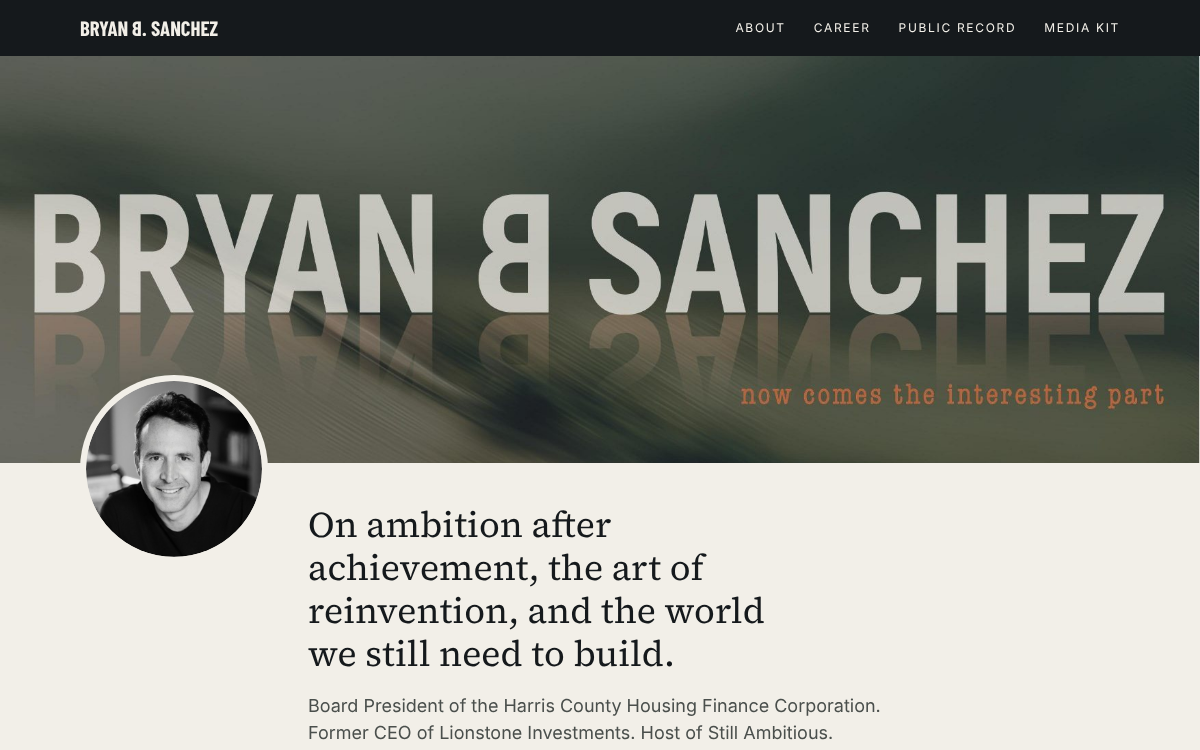
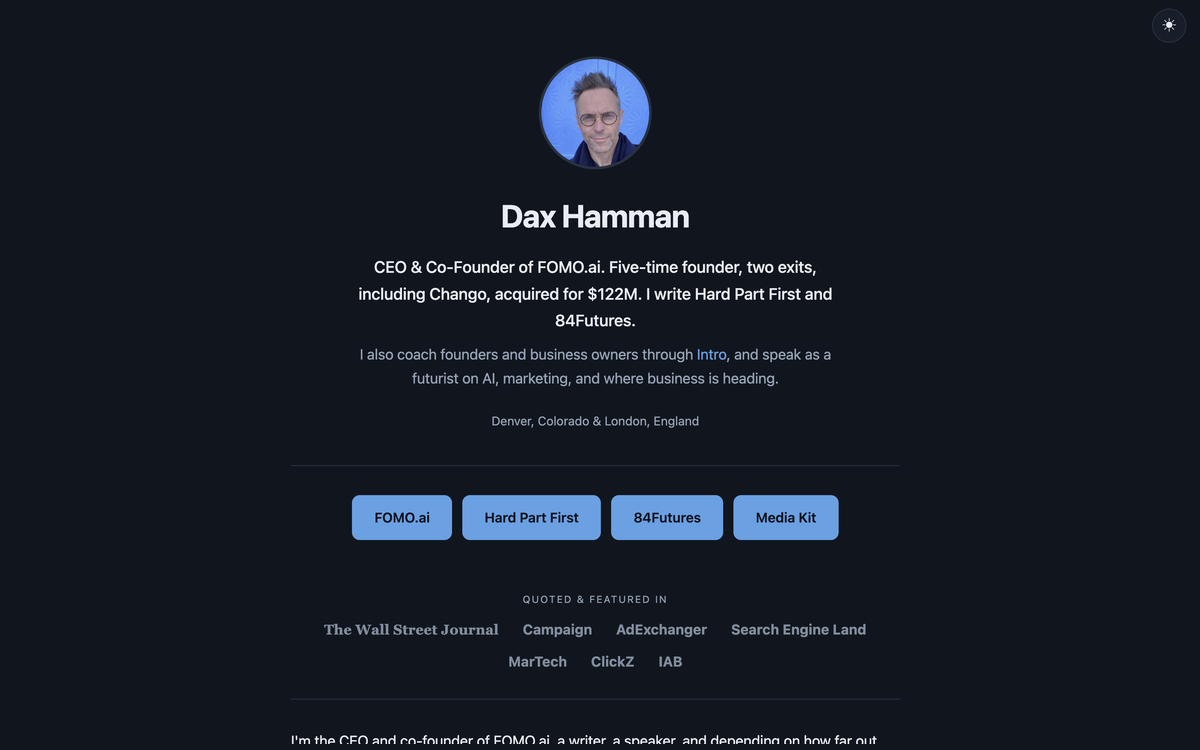
Google had split Dax (a Founder & CEO) into two people. His record was out of date and his best work was invisible. Investors and hosts looked him up, saw the wrong thing, and moved on.
One record of who he is and what he has done, on his own domain, updated with every new interview. Google merged the two profiles and he claimed his knowledge panel in September 2026. AI assistants now describe him accurately and cite dax.fyi as the source.
More podcast bookings. More consultancy relationships. The right investors taking the meeting. Linking the record to his company site (FOMO.ai) and newsletters lifted those in search too. Online, he now looks like the person he actually is.
Google, ChatGPT and the other assistants do not read a leadership page the way a recruiter does. Underneath the words there is a hidden layer (called schema) where a page states who someone is in a form Google and AI can trust: this is a person, they held this role at this company between these dates, and these profiles all belong to them.
Data sites have that layer, which is why their version of you gets quoted. Most company bios and personal pages have none of it. We build it for you on a domain you own and connect it to the sources that already carry weight, the company filings, press releases and interviews, so every one of them points back at the same person.
Rarely. The page states roles and facts that are already public, and it is written in your voice, not the company's. If you have a communications team we send it to them before it goes live, and we would rather they saw it.
LinkedIn sits behind a login, so the AI assistants cannot read most of it, and it is LinkedIn's page about you, not yours. Keep it. Your record is the page it should agree with, and the one that still exists if your account, or the platform, changes.
Only what is already public: your role, your dates, your published bio, your talks and your interviews. No forecasts, no numbers that are not in a filing or a release, and nothing about the company's plans. You confirm every line before it is published.
No. They work on what you say and where you say it. We make sure that when their work sends people to look you up, what Google and the AI assistants say is accurate. Most agencies are glad somebody is doing it.
It gives a nominating committee a board bio to find when it searches your name, which most candidates do not have. It states your sectors, the scale you have run, your governance experience and your other seats. It does not get you the seat.
No. The company site is about the company, and the leadership page changes the day you do. Your record is about you, sits on a domain you own, and points at the company page rather than competing with it.
That is one of the most useful things we do. Your record states plainly who you are, where you have worked and when, and we make every profile use one name form, so the search engines have something to separate you by. Common names take longer than most.
Yes. They can hold the login, answer our questions and approve the monthly updates. The strategy call is the one thing we ask you to attend yourself.
Nobody can promise that. Google decides when it is confident, and we build the record it reads, make every source agree, and teach you the claim process for the day it appears.
A free score out of 100 for how well AI and Google know you, run live with you on a call. We ask ChatGPT, Perplexity, Gemini and Google's AI Overview who you are and score five things, 20 points each: recognition, accuracy, distinctness from people who share your name, source strength and consistency. Under 40 means AI is mostly guessing, 40 to 69 means it knows you in part, and 70 and up is strong.
Your Identity everywhere people search. We measure it with your Identity Score before we start and again 90 days after launch, with the same prompts and tools, and if it has not improved the way our Terms set out, we keep working at no extra cost until it has. It is a promise to keep working, not a refund. It applies once you have done your part, and it never promises a knowledge panel or any specific Google feature. The Terms have the detail.
Plain explanations, written for people with no time. No pitch inside.
An executive bio now has two readers, the person deciding whether to meet you and the AI assistant they asked first. How to write one in three lengths, with examples you can adapt.
How board seats are actually filled, what to prepare before you ask for one, and the step most candidates miss, which is what a nominating committee sees when it searches your name.
Executive positioning is the choice of what you are known for. Before you choose, find out what Google and the AI assistants already say, because that is the position you currently hold.