Knowledge panels
How to get a Google knowledge panel for yourself, the honest version
The sequence that actually produces a knowledge panel for a person, in order, with the common mistakes that stop it from working.
The box with your photo, title and facts beside your name is not something you sign up for, buy, or write. Google builds it when enough sources it trusts agree about who you are, and it shows it when it is confident. Most of what is sold as a shortcut gets removed, and a removed panel is harder to rebuild than one that never existed. MeMyself.fyi builds what a panel is actually made from, on your own domain, in seven days, and teaches you to claim it the day it appears.

Half the confusion about panels comes from mixing them up with things that look similar. Clear that up first and the rest follows.
That is the map listing for a place with an address and opening hours, and you can set one up yourself. A person's panel has no sign up form.
There is no knowledge panel account. The claim lives on the search results page, and the nearest thing to a dashboard is Search Console for your own site.
Plenty of people have a panel and no article. Wikipedia helps when it exists; it is not the entry ticket.
Anyone selling you a panel is selling the work of building sources that agree, or something that Google removes. The first is honest when it is priced honestly; the second costs you the panel you might have had.
Google decides, on its own schedule, and does not say why. Everything below is about making the decision easy, not forcing it.
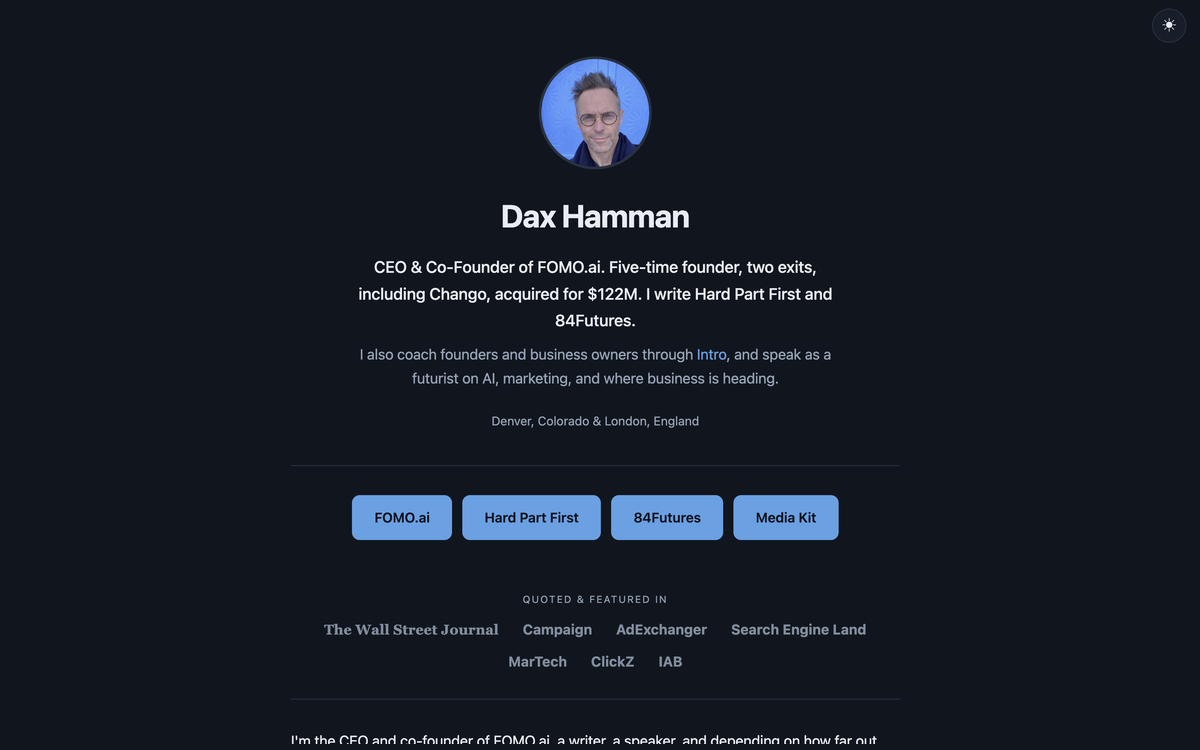
This is how it went for Dax Hamman, our founder's own record at dax.fyi, which is the pattern every client build follows. Dates and steps as they happened, not as a sales page would like them to have happened.
A page on his own domain stating every fact plainly (born, education, citizenship, roles, every profile), carrying one Person node in the hidden layer, with every profile he controls pointing back at it and using one exact name form.
Profiles brought into line, a Wikidata entry filed with a source on every claim, Search Console connected on the domain, and a press release so the web had a dated third party page to point at.
The panel was claimed and verified in September 2026, signed in as an account on the domain the panel listed as his website. A Gmail address would have proved nothing; the domain email did.
A stale author bio on an old industry outlet, with a title he had not held for years, fed a second entity under the same name. For weeks the two competed and the plain name search stopped showing the panel, even though it still existed.
Chase the stale bio by email, submit feedback through the panel itself with the record and Wikidata as the sources, and check both entity IDs monthly in a private window. Nothing about it is a trick, and all of it is what the monthly plan does.
Weeks to months, not days. The timeline is Google's; the groundwork is yours.
Each one has a full post behind it. The short answers are here.
Already have one?
Which account to use, why verification fails, and what to do when the claim link is missing. How to claim your knowledge panel.
Buying
No. What the sellers actually do, why some of it gets panels removed, and what honest help looks like. Are knowledge panel services legit?
Disappeared
Usually merged, split by a namesake, or dropped when a source changed. How to tell which, and what brings it back. Why your knowledge panel disappeared.
Not showing
The entity is there and the search does not trigger it. The kgmid test, and the triggering problem explained. Your panel exists but does not show.
Artists
The path runs through the music and streaming platforms as well as the record, and the claim has a few extra steps. Knowledge panels for artists and musicians.
Confusion
No, and the two get mixed up constantly. Which one you need, and whether you need both. Knowledge panel versus Google Business Profile.
Google does not read your website the way a person does. Underneath the words there is a hidden layer (called schema) where a page states who someone is in a form Google and AI can trust: this is a person, they do this, they work here, and these profiles all belong to the same human. That layer is how the Knowledge Graph keeps track of people, and when it is missing Google guesses from whatever it can find.
A panel is what you get when enough of those sources agree and none of them contradicts. The record on your own domain is the one you control. The profiles, Wikidata and other people's pages are the corroboration. Fame is not a requirement; agreement is.
Read more: The Google Knowledge Graph, explained
Everything on this page comes down to one thing: a record Google can read, and sources that agree with it. That is what the Foundation builds, on your own domain, in seven days. We never promise the panel, because Google decides it. We promise the groundwork, the claim process taught step by step, and a monthly check on the panel once it exists.
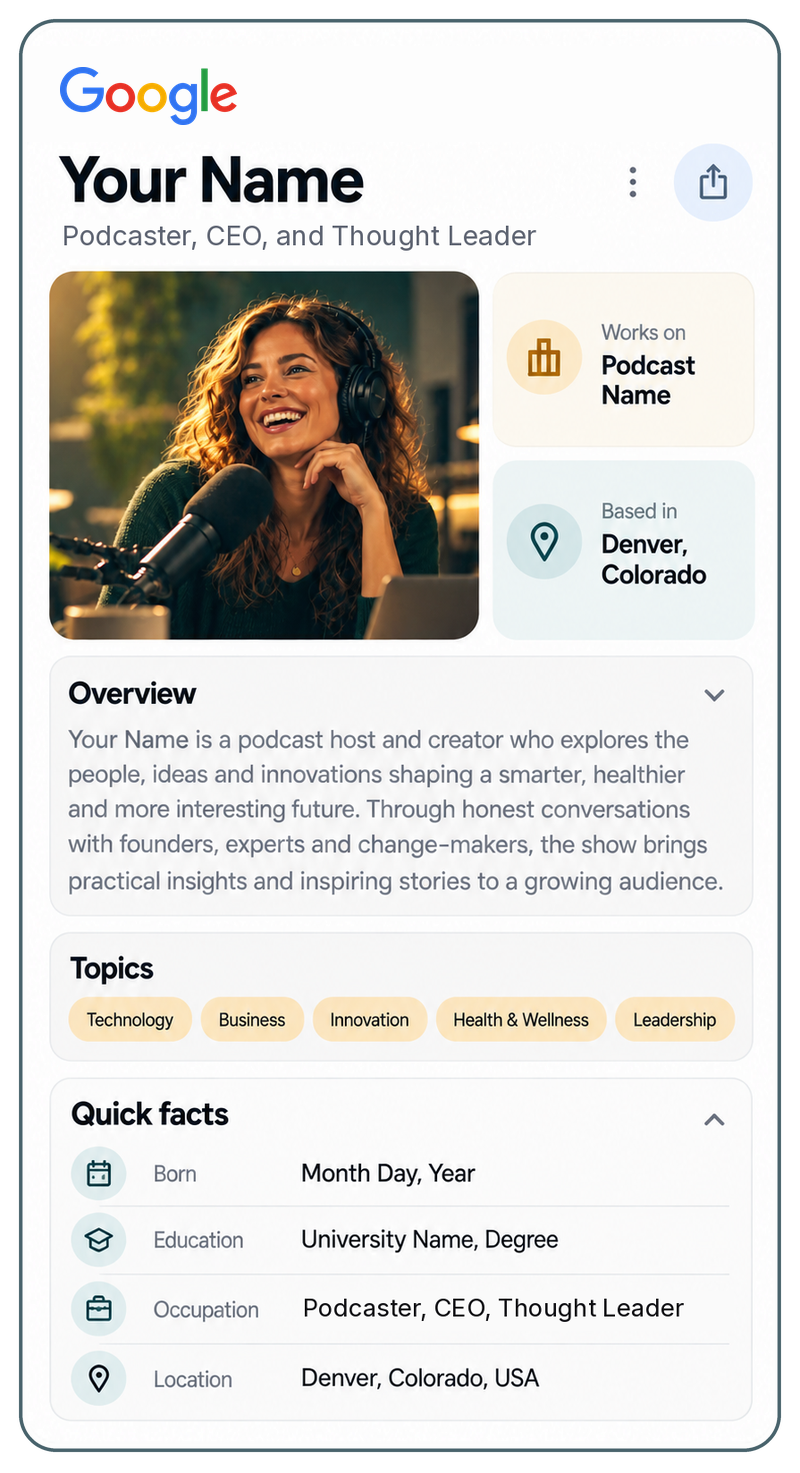
Google Knowledge Panel
Google builds one when enough trusted sources agree about who you are. The record, the matching profiles, the collected coverage and the Wikidata entry are exactly that agreement. When a panel appears we walk you through claiming it, and after the claim you control the photo, the subtitle and the links.
Wikidata
Wikidata is the open database behind Wikipedia, and Google treats it as a source it trusts. Where you qualify, with at least one independent outlet having written about you, we create and reference the entry as part of the setup. It is often the first thing to move facts like education and birthplace into a panel.
Wikipedia
Wikipedia's bar for a living person is high and we will tell you plainly whether you clear it. If you do, the record and the collected coverage are what an article is written from, and we will never edit it on your behalf. Can you make a Wikipedia page about yourself?
Read more: Can you get a knowledge panel for free?
The first step does most of the work, and for a knowledge panel it is a conversation about what Google already believes about you, and what contradicts it, not a form.
One conversation about you: who you are, what you have done, and what you want this to do, whether that is a panel beside your name, or simply a correct answer when someone checks you. Then we search the web for everything already written about you, including every profile, bio and page that mentions you, what Google's panel already says if one exists, and what belongs to a namesake.
Everything we found becomes a fact set you approve line by line, and nothing unconfirmed goes live. Any stale page that is feeding Google the wrong facts is named here, with who we will ask to fix it. From it we decide what your record needs to say, then build your site on your own domain, written so Google and the AI assistants can read it, with your media kit alongside.
Your site goes live and a press release announces it. We connect Search Console, file Wikidata where you qualify, and give Google its first corroborated look at one consistent you, and capture how Google and the AI assistants describe you on day one, at launch and again at day 90, so you can watch them catch up.
All of it live by day seven. Yours, not rented from a platform.
Tell us when something happens. A new role, a talk, an article, an award, a change of headshot. It goes into your record, your site updates, and the web gets one more thing that agrees with everything else.
The site is what people see.
The record is what Google & the web read.
You need both.
Three records built this way. Yours can look however you want: any color scheme, any layout, your own photos. The hidden layer underneath, the part a panel is built from, is the same on every one.

 Seen onShark Tank

One Foundation to build the record, then Evolve to keep it current, or Amplify to add a press release every quarter. Leave any time and take your files.
Build the record.
Every item in the checklist above, live on your own domain by day seven: your record, your site and media kit, your profiles brought into agreement, a press release, Search Console and Wikidata where you qualify, with the course for the day a panel appears.
We keep it current and check the panel every month.
$149 a month, or $1,490 a year. Leave any time and take your complete site files.
Everything in Evolve, plus a press release every quarter.
$295 a month, or $2,950 a year. Leave any time and take your complete site files.
Learn exactly what Google and Wikipedia look for, and whether you meet it: how Google decides who you are, what counts as independent evidence, Wikidata, claiming a knowledge panel, Wikipedia's criteria and the proper routes, and a readiness scorecard that tells you plainly where you stand. Module 0 is free. We teach the criteria. Google decides the panel.
See every plan, including Authority, from $750 a month by application. A knowledge panel is a result Google decides, so we build what it is made from and never promise it.
IncludedNot included
| Foundation$2,500 once | Evolve$149 a month, starts at site launch | Amplify$295 a month | AuthorityFrom $750 a month, by application | |
|---|---|---|---|---|
| Site, record, hidden layer and media kit | Built | Kept live and true as you change | Kept live and true as you change | Kept live and true as you change |
| Hosting, SSL and uptime | At launch | Included | Included | Included |
| Email routing on your domain kept working | Not included | Included | Included | Included |
| Structured data and health check each quarter | Not included | Included | Included | Included |
| New appearances, writing, roles and projects added | Not included | Up to four updates a month | Up to four updates a month | Included |
| Search Console | Set up, indexing requested | Monthly report | Monthly report | Monthly report |
| AI answer check | Day one, launch and day 90 | Quarterly review | Quarterly review | Quarterly review |
| Knowledge panel | Everything Google reads to build one | Monthly check | Monthly check | Monthly check |
| Wikidata | Created if you qualify | Kept in agreement with your record | Kept in agreement with your record | Kept in agreement with your record |
| Press releases, written to be found in Google and AI | One | Not included | One a quarter | More frequent |
| Podcast guest opportunities | Not included | Not included | Not included | Included |
| Interviews and PR | Not included | Not included | Not included | Included |
| Guest article opportunities | Not included | Not included | Not included | Included |
| Claim your Google Knowledge Panel course | Included | Included | Included | Included |
| Kickoff and positioning call, plus the readiness check | Included | Not included | Not included | Not included |
When Google has no panel for you and the assistants can only guess, the person checking you sees someone less established than you are, and sometimes someone else entirely. MeMyself pulls your roles, your work and your authority into one trusted record, which is the thing a panel is made from and the thing the assistants read either way.
Google had split Dax (a Founder & CEO) into two people. His record was out of date and his best work was invisible. Investors and hosts looked him up, saw the wrong thing, and moved on.
One record of who he is and what he has done, on his own domain, updated with every new interview. Google merged the two profiles and he claimed his knowledge panel in September 2026. AI assistants now describe him accurately and cite dax.fyi as the source.
More podcast bookings. More consultancy relationships. The right investors taking the meeting. Linking the record to his company site (FOMO.ai) and newsletters lifted those in search too. Online, he now looks like the person he actually is.

No WordPress, no plugins, no database. Your page is pure: your words and the hidden layer the assistants read, served from Cloudflare's global network, with nothing inside it that can be hacked, auto updated or quietly changed.
The box Google shows beside a search for a person, company or thing it is confident about: for a person, a photo, a one line subtitle, a short overview, key facts and links to profiles. It is built from Google's Knowledge Graph, which is assembled from sources that agree about who you are. It is not a Google Business Profile, it has no sign up form and no login, and nobody can buy one.
You make it easy for Google to be confident. A page on your own domain stating your facts plainly and carrying the hidden layer, every profile you control using one name form and pointing at it, a Wikidata entry where you qualify, and other people's pages that describe you the same way. Google builds the entity when enough of that agrees. There is no form to fill in and no way to request one.
Weeks to months, on Google's schedule, and it varies by name. Our founder's own panel followed the record, the profile cleanup, Wikidata and a press release, and then a stale third party bio spawned a duplicate entity that took further weeks of feedback and chasing to resolve. The site is live in 7 days; the panel is a result of what happens after, and we never promise it.
No. Google does not sell them. What the sellers offer is either the legitimate work of building sources that agree, which is fine when it is priced honestly and promises nothing, or shortcuts such as thin pages and manufactured profiles, which Google removes, and a removed panel is harder to rebuild than one that never existed.
No. Plenty of people have a panel and no Wikipedia article, because their own page, their profiles, Wikidata and other people's pages agree. Wikipedia helps when it exists, and for most people it will not, which is why we never make it the plan.
Usually one of three things: it was merged into another entity, a namesake's facts split it, or a source it was built from changed or vanished. Search the entity ID in the All tab of a private window: if it still resolves the panel exists and is not triggering; if it does not, it was merged or dropped, and the fix is the record and the sources again.
No. A Business Profile is the map listing for a place with an address and opening hours, and you set it up yourself. A person's knowledge panel is built by Google from sources about you, and you can only claim it once it exists. A professional with a practice may want both; they are separate things.
Search your name signed in to a Google account tied to a property the panel lists, usually an address on your own domain with Search Console verified, click Claim this knowledge panel, and verify through one of the properties Google offers. The claim page on this site walks through it, including what to do when the button is missing or verification fails.
Nobody can promise that. Google decides when it is confident, and we build the record it reads, make every source agree, and teach you the claim process for the day it appears.
Ten posts cover every part of this. Start with these three.
The sequence that actually produces a knowledge panel for a person, in order, with the common mistakes that stop it from working.
Nobody can give you a date, and anyone who does is selling something. But the phases have shapes, and they are predictable enough to plan around. What happens in each, what speeds it up, what stalls it, and the monthly check that tells you where you are.
A plain explanation of the Google knowledge panel, where it comes from, why most people never get one, and how to check whether Google has an entity for you.