Personal reputation management, without the suppression games

Something about your name search is bothering you. A directory page that outranks you, an old employer's bio, a namesake's arrest beside your career, a ChatGPT answer that gets you wrong, or nothing at all. The reputation industry sells a monthly retainer to push it down. Most of those problems do not need pushing down. They need one page that states who you are, in the form Google and the AI assistants trust, with every profile agreeing with it. MeMyself.fyi builds that record on your own domain in seven days, and says plainly what it will not do.

A woman raising her hand above a crowd of people, lit by golden light

What is actually wrong with your name search

Search your name in a private window, then ask ChatGPT who you are. For most people the problem is one of these four, and none of them is a scandal.

  • There is almost nothing

    Your name returns a LinkedIn page, a company roster and a stranger. Google and the assistants have so little to go on that they guess, and they guess from whatever is loudest.

  • What there is, is out of date

    A title you left two promotions ago, a company that no longer exists, a bio someone else wrote in 2019. The assistants repeat it as if it were today.

  • A directory owns the first screen

    Avvo, Healthgrades, Zillow, Crunchbase, a people search site. Their page about you exists to show the visitor somebody else, and it outranks anything you own.

  • Someone else has your name

    A namesake's arrest, bankruptcy or politics sits beside your career, and the assistants stitch the two into one person. The reader never knows which parts were yours.

Most of what gets sold as reputation management is a correction, not a cover up.

What we fix, and what we do not

Reputation management covers five different problems under one phrase. We take four of them. The fifth needs a lawyer or a specialist, and we will say so on the first call rather than sell you a retainer for it.

We fix

  • Thin: there is nothing about you. We build the record on your own domain, in the hidden layer Google and the assistants read, and give every profile something to point at.
  • Wrong: the facts are stale. We state the current facts once, confirmed by you, then ask the owners of the old pages to update them or point at your record.
  • Outranked: a directory owns your name. We build the page that deserves to sit above it and make every profile agree with it, so Google has a reason to show yours first.
  • Blended: a namesake is mixed in with you. We fix one exact name form everywhere, state who you are and where, and give the assistants what they need to tell you apart.
  • What AI says. ChatGPT, Gemini and Perplexity describe you from whatever agrees. We give them a record that does, and show you the before and the after.

We do not

  • Remove or bury a true article

    If a story is accurate and lawful, no form removes it. We give it context on a page you control and a record strong enough that it becomes one item among many.

  • Remove reviews

    Honest reviews stay. Fake ones are for the platform to deal with, and we will tell you where to report them.

  • Remove court or public records

    They are public. The record gives them context. It does not make them disappear.

  • Send legal letters

    Anything false or defamatory is a lawyer's job first, and we are not lawyers. We will tell you to see one before you spend anything with us.

  • Run suppression campaigns

    Networks of thin pages and paid links can breach Google's spam rules, and when they do, the damage lands on your name.

If the problem is private information, such as your home address or phone number showing in results, that is a privacy matter rather than a reputation one. Google has a removal request for exactly that, and we will point you at it for nothing.

Why your own page comes first, whatever else you do

Every honest reputation plan, including the expensive ones, starts the same way: build pages you own, so the system has something better to show than the thing you dislike. The difference is in what gets built. A bio page in prose gives Google words to skim. A record carries the hidden layer (called schema) that states who you are in a form Google and AI can trust: this is a person, they do this, they work here, and these profiles all belong to the same human.

That layer is what directories have, which is why they outrank you, and what almost no personal site has. With it in place, and every profile agreeing with it, Google and the assistants stop guessing. Without it, every page you publish is one more opinion competing with the directory's.

  • You described once, on a page you own, in the form Google and AI trust
  • Every profile you control marked as the same person, in one name form
  • Your companies, roles and work connected to you, not just mentioned
  • Stale pages chased, and pointed at the record instead of contradicting it
  • An entry in Wikidata where you qualify, the open database Google reads directly
  • Progress you can see: what Google and the assistants say on day one, at launch and at day 90

Read more: Online reputation management for a person: suppression versus a record that holds

The foundation for Google Knowledge Panels and more

Some reputation firms now sell knowledge panels as the fix. Google does not sell panels, and a panel propped up by thin pages gets removed, and is harder to rebuild afterwards. We build what a panel is actually made from: your page, your profiles in agreement, the pages that back you up, and Wikidata where you qualify. Google decides who gets a panel, so we never promise one. What a strong record does promise is that when someone searches you, there is something of yours to find.

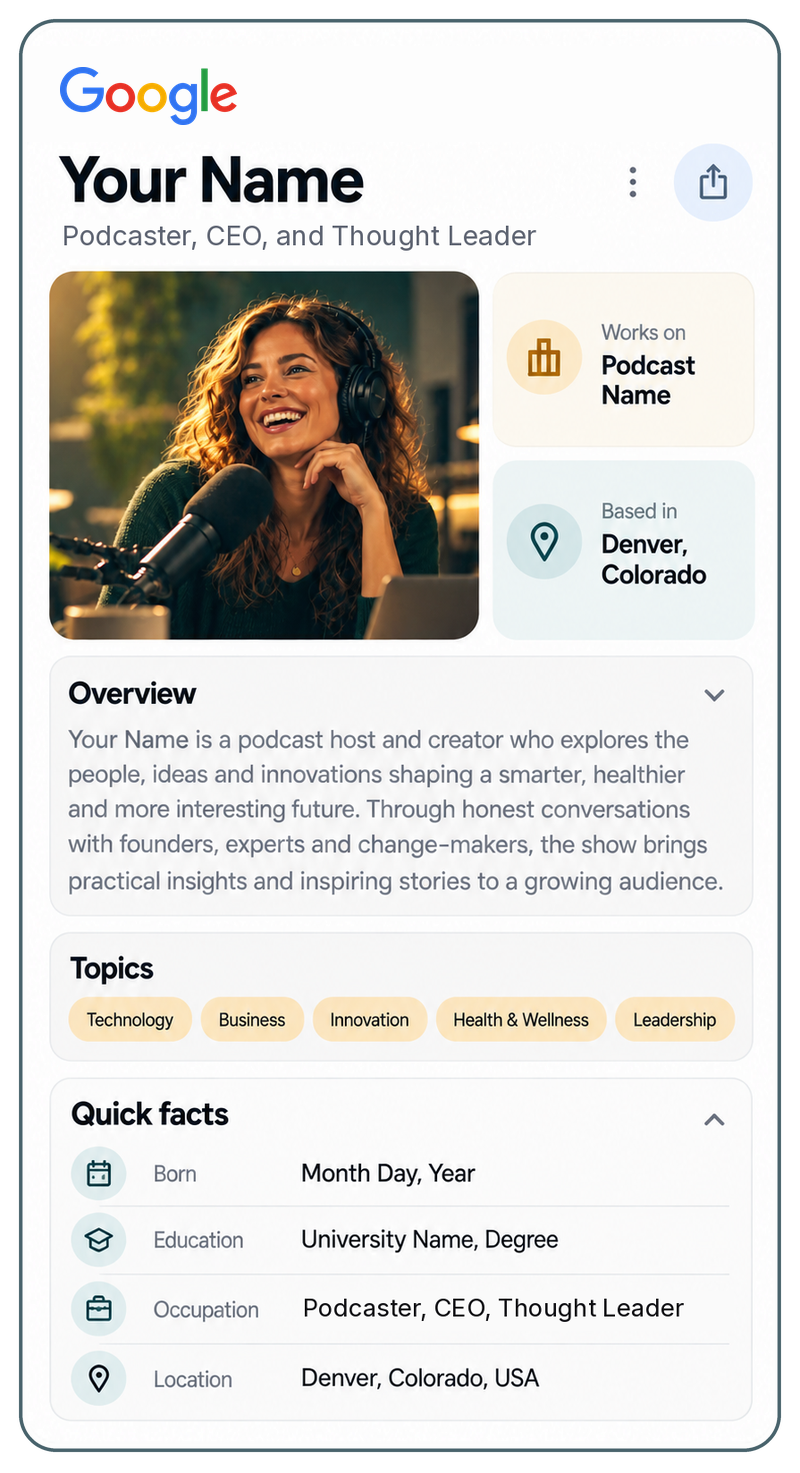
Example of a knowledge panel, with a photo, a short overview, topics and quick facts

Google Knowledge Panel

A knowledge panel beside your name

Google builds one when enough trusted sources agree about who you are. The record, the matching profiles, the collected coverage and the Wikidata entry are exactly that agreement. When a panel appears we walk you through claiming it, and after the claim you control the photo, the subtitle and the links.

Wikidata

A Wikidata entry Google reads directly

Wikidata is the open database behind Wikipedia, and Google treats it as a source it trusts. Where you qualify, with at least one independent outlet having written about you, we create and reference the entry as part of the setup. It is often the first thing to move facts like education and birthplace into a panel.

Wikipedia

A Wikipedia article, for the few who qualify

Wikipedia's bar for a living person is high and we will tell you plainly whether you clear it. If you do, the record and the collected coverage are what an article is written from, and we will never edit it on your behalf. Paid editing is the fastest way to a public deletion discussion about you.

Read more: Are knowledge panel services legit?

Seven days, three steps

The first step does most of the work, and for a reputation problem it is a conversation about what is wrong and which of it is fixable, not a form.

Day 1

The kickoff call

One conversation about you: who you are, what you have done, and what you want this to do, whether that is clients, referrals or simply a correct answer when someone checks you. Then we search the web for everything already written about you, including every directory profile, stale bio, review page and news item under your name, and everything that belongs to a namesake.

Day 4

The strategy and the build

Everything we found becomes a fact set you approve line by line, and nothing unconfirmed goes live. Anything a record cannot fix, such as a true article or a public record, is named plainly here, with what can be done about it instead. From it we decide what your record needs to say, then build your site on your own domain, written so Google and the AI assistants can read it, with your media kit alongside.

Day 7

Live, published and tracked

Your site goes live and a press release announces it. We connect Search Console, file Wikidata where you qualify, and ask the owners of stale or wrong pages to update them or point at your record, and capture how Google and the AI assistants describe you on day one, at launch and again at day 90, so you can watch them catch up.

What you walk away with

All of it live by day seven. Yours, not rented from a platform.

  • A bio site on your own domainWho you are, what you have done, where to find you. Custom built, hosted at launch, yours and not rented from a platform.
  • The record underneath itEvery fact confirmed by you, stated in one name form, with your bio rewritten for AI search and the hidden layer the assistants read on every page.
  • Your profiles and stale pages brought into agreementLinkedIn, X, the directories and old bios saying the same name and facts, pointing at the same page, with the stale ones chased.
  • A media kit for the people who vet youBio, headshot, roles and the facts that matter, ready for anyone checking you before they call.
  • A press release at launchWritten, sent to real news and finance outlets, and linked back to your record, so the web has a reason to point at you from day one.
  • Registered where it countsSearch Console connected with indexing requested, a Wikidata entry filed where you qualify, and a plain Wikipedia readiness check either way.
  • Knowledge panel foundationEverything Google reads to build one, plus the Claim your Google Knowledge Panel course for claiming it. Only Google decides who gets a panel.
  • Your AI answer baselineWhat Google, ChatGPT, Claude, Gemini and Perplexity say about you on day one, at launch and at day 90, so you can watch them catch up.
  • The kickoff and positioning callOne call: what is wrong with your name search, which of it we can fix, what this is for, and the angle that makes the right people confident.

Then, ongoing

Tell us when something happens. A new role, a talk, an article, a resolved matter, a namesake who appears. It goes into your record, your site updates, and the web gets one more thing that agrees with everything else.

The site is what people see.
The record is what Google & the web read.
You need both.

Example MeMyself.fyi profiles

Three records built this way. Each one replaced a name search that was thin, stale or split in two. Yours can look however you want: any color scheme, any layout, your own photos. The hidden layer underneath is the same on every one.

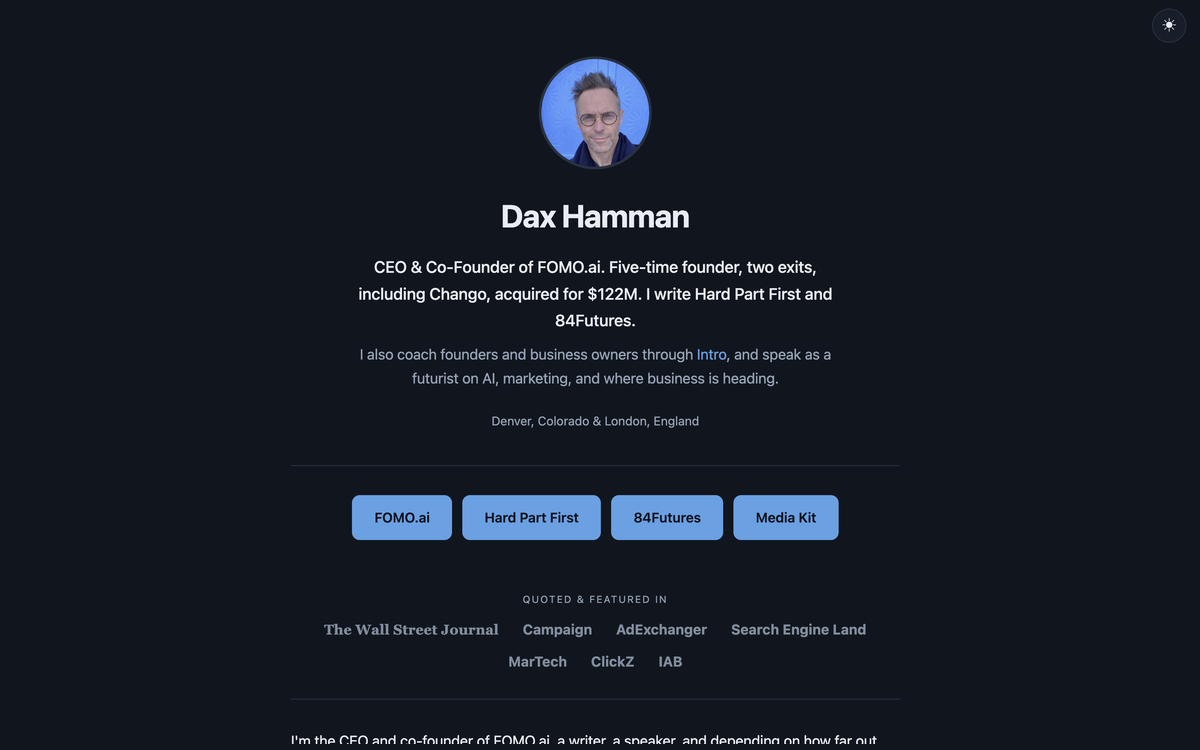
Screenshot of dax.fyi, Dax Hamman's profile
Dax Hamman
Dax HammanCEO and co-founder, FOMO.ai
Screenshot of joshthurmond.com, Josh Thurmond's profileSeen onShark Tank
Josh Thurmond
Josh ThurmondFounder and CEO, LavaBox Portable Campfires
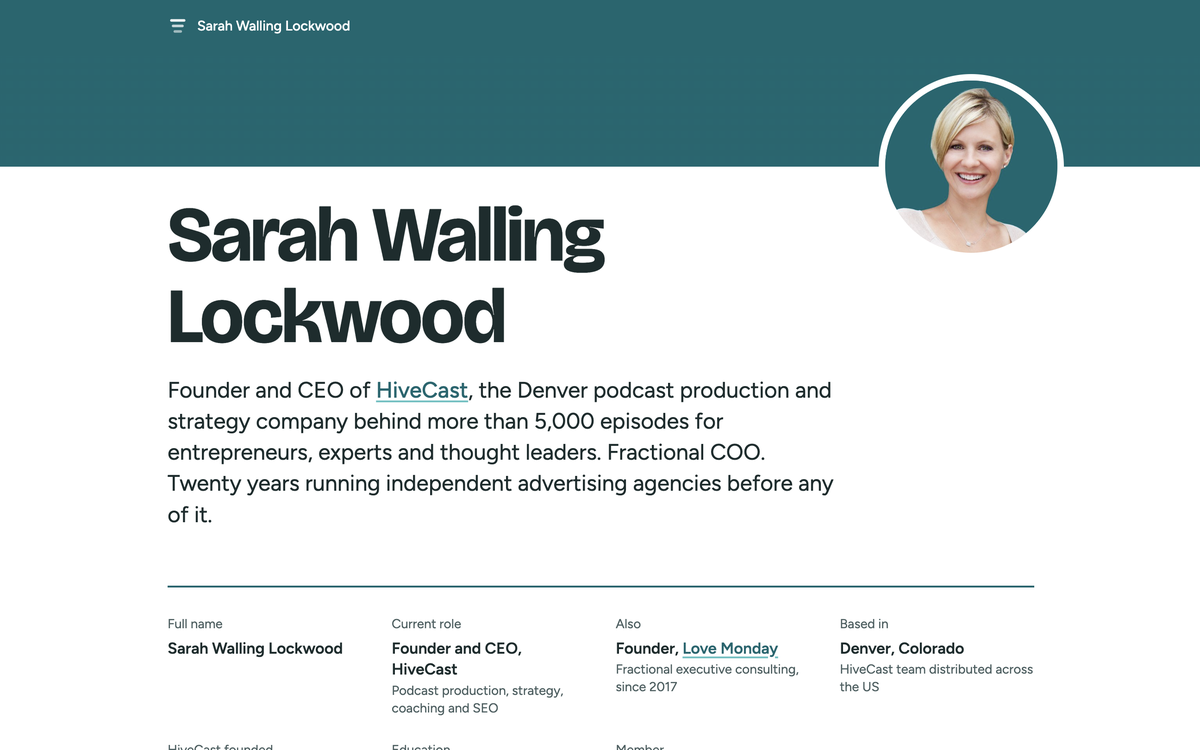
Screenshot of sarahwallinglockwood.com, Sarah Lockwood's profile
Sarah Lockwood
Sarah LockwoodFounder and CEO, HiveCast

Plans

One Foundation to build the record, then Evolve to keep it current, or Amplify to add a press release every quarter. Leave any time and take your files.

Foundation

$2,500once, delivered in 7 days

Build the record.

Every item in the checklist above, live on your own domain by day seven: your record, your site and media kit, your profiles brought into agreement and the stale ones chased, a press release, Search Console and Wikidata where you qualify.

See everything includedHide the full list
  • Your new bio home siteCustom designed and built on your own domain, stating who you are and what you have done.
  • Your media kitThe page producers and bookers use to say yes in ten seconds.
  • Your record, confirmedEvery fact about you, sourced and confirmed by you before anything goes live.
  • Optimized bio description for AI searchYour story rewritten dense and sourced, in the exact form AI tools quote correctly.
  • The full hidden layer, on every pageThe structured data Google's knowledge graph and the AI assistants actually read.
  • Every profile brought into agreementLinkedIn, X and the rest, matched to the one name and headshot your site states.
  • Wikidata and Wikipedia, handled honestlyAn entry filed in Wikidata where you qualify, plus a plain readiness check against Wikipedia's own criteria either way.
  • Search Console, set up and trackingConnected to your domain, with indexing requested on both pages.
  • One press release, written and sentDistributed to real news and finance outlets, linked back to your record.
  • AI answer trackingWhat Google, ChatGPT, Claude, Gemini and Perplexity say about you on day one, rechecked at launch and again at day 90.
  • Knowledge Panel foundationsEverything Google needs to build one, in place, though only Google decides who gets a panel.
  • The Claim your Google Knowledge Panel courseWalks you through claiming your panel the moment one appears.
  • The kickoff and positioning callOne call to get everything we need from you, agree what this is for, and settle the topics you own and the angle that gets you booked.
Starts at site launch

Evolve

$149a month

We keep it current, so the record stays stronger than whatever appears next.

  • New roles, articles, talks and press added, up to four updates a month
  • Hosting, uptime monitoring and a quarterly checkup
  • A monthly report on who is searching your name, and a knowledge panel check
  • A quarterly review of what AI says about you

$149 a month, or $1,490 a year. Leave any time and take your complete site files.

Amplify

$295a month

Everything in Evolve, plus a press release every quarter.

  • Everything in Evolve
  • One press release a quarter, written for you and sent out
  • Written and optimized to be found in Google, AI Overviews and AI assistants
  • Timed to your news, such as a new role, a launch, a book or an award

$295 a month, or $2,950 a year. Leave any time and take your complete site files.

Claim your Google Knowledge Panel, our course. Included with every plan.

Learn exactly what Google and Wikipedia look for, and whether you meet it: how Google decides who you are, what counts as independent evidence, Wikidata, claiming a knowledge panel, Wikipedia's criteria and the proper routes, and a readiness scorecard that tells you plainly where you stand. If your problem includes a panel that shows the wrong thing, it also covers claiming and correcting one.

See every plan, including Authority, from $750 a month by application. A knowledge panel is a result Google decides, so we build what it is made from and never promise it.

Compare every plan

IncludedNot included

Foundation$2,500 onceEvolve$149 a month, starts at site launchAmplify$295 a monthAuthorityFrom $750 a month, by application
Site, record, hidden layer and media kitBuiltKept live and true as you changeKept live and true as you changeKept live and true as you change
Hosting, SSL and uptimeAt launchIncludedIncludedIncluded
Email routing on your domain kept workingNot includedIncludedIncludedIncluded
Structured data and health check each quarterNot includedIncludedIncludedIncluded
New appearances, writing, roles and projects addedNot includedUp to four updates a monthUp to four updates a monthIncluded
Search ConsoleSet up, indexing requestedMonthly reportMonthly reportMonthly report
AI answer checkDay one, launch and day 90Quarterly reviewQuarterly reviewQuarterly review
Knowledge panelEverything Google reads to build oneMonthly checkMonthly checkMonthly check
WikidataCreated if you qualifyKept in agreement with your recordKept in agreement with your recordKept in agreement with your record
Press releases, written to be found in Google and AIOneNot includedOne a quarterMore frequent
Podcast guest opportunitiesNot includedNot includedNot includedIncluded
Interviews and PRNot includedNot includedNot includedIncluded
Guest article opportunitiesNot includedNot includedNot includedIncluded
Claim your Google Knowledge Panel courseIncludedIncludedIncludedIncluded
Kickoff and positioning call, plus the readiness checkIncludedNot includedNot includedNot included

Don't let an old result decide for you

You might have the stronger record and the better work. If Google shows a directory page or a namesake first, and AI can only guess, the person checking you sees the opposite. MeMyself pulls your roles, your work and your authority into one trusted record, so what is true about you is also what gets found.

Case study: Dax Hamman

Before

Google had split Dax (a Founder & CEO) into two people. His record was out of date and his best work was invisible. Investors and hosts looked him up, saw the wrong thing, and moved on.

With MeMyself.fyi

One record of who he is and what he has done, on his own domain, updated with every new interview. Google merged the two profiles and he claimed his knowledge panel in September 2026. AI assistants now describe him accurately and cite dax.fyi as the source.

Result

More podcast bookings. More consultancy relationships. The right investors taking the meeting. Linking the record to his company site (FOMO.ai) and newsletters lifted those in search too. Online, he now looks like the person he actually is.

A woman smiling in a crowd of people, lit by golden light

A site that loads instantly, never breaks, and is always yours

No WordPress, no plugins, no database. Your page is pure: your words and the hidden layer the assistants read, served from Cloudflare's global network, with nothing inside it that can be hacked, auto updated or quietly changed.

Read: how your site is built and hosted
  • Nothing changes without your approval. No plugin update rewrites a page, no template adds a word you did not confirm. What you approved is what stays live.
  • Nothing to hack. No login page, no database, no admin panel. A reputation page that gets defaced is worse than none, and there is nothing here to break into.
  • Fast everywhere. A pure page passes Google's loading tests on a phone without trying, which matters when someone checks you between meetings.
  • Ready for AI agents. The first visit is increasingly an AI assistant researching you for someone else. A clean page with the hidden layer gives it one clear answer in one read.
  • Yours, whatever happens. The domain is registered to you. Change jobs, close a company or move cities and nothing about the site has to move.

Before you ask

Can you remove a negative article about me from Google?

No, and neither can anyone else if the article is accurate and lawful. Google removes results only in defined cases, mostly private contact details and content that is unlawful where you live, and even then the page stays on the site that published it. What a record does is give the article context on a page you control and surround it with current, consistent pages about you, so it becomes one item among many rather than the whole answer. If the article is false, see a lawyer first. We will say the same on the call.

What does personal reputation management cost?

Here it is the Foundation, $2,500 once, delivered in 7 days, then Evolve at $149 a month to keep the record current. Reputation retainers are usually priced by the month for as long as the suppression has to be maintained, and the work stops working when you stop paying. A record is simply true and consistent, so it keeps working after the invoice does.

How long does reputation management take to work?

The site is live in 7 days. Google reweights what it shows over weeks to months as it finds the record and the profiles that agree with it. Assistants that search the web live reflect it within weeks of indexing; the ones answering from training data catch up when their models refresh. The check at day 90 tells you which is which, in writing.

Does this work on ChatGPT, Gemini and Perplexity, or just Google?

On all of them, and it is the only approach that does. Suppression rearranges a list of links. An assistant does not have a list; it builds an answer from the sources it can read, and if those are thin or contradictory it leans on whatever is loudest, including the thing you wanted buried. A record that agrees with itself gives it something better to say.

Someone with my name has a criminal record. Can that be separated from me?

Usually, yes, and it is one of the most useful things we do. We fix one exact name form everywhere, state plainly who you are, where you are and what you do, and give Google and the assistants enough to tell the two of you apart. Common names take longer than rare ones.

My old employer still has my bio up. Can you get it taken down?

We ask, politely and with your current bio and a link to your record attached, and most firms update or remove it. We cannot force them. Either way your record states the current facts, and the stale page becomes the one source that disagrees with everything else, which is how Google learns to ignore it.

What if the problem is my home address or phone number showing up?

That is a privacy problem, not a reputation one, and Google has a removal request for exactly that. We will point you at it, and at the host site's own process, for nothing. It is not something you should pay us for.

Can I do this myself?

Yes. The course, Claim your Google Knowledge Panel, is included with every plan and module 0 is free. It covers how Google decides who you are, what counts as independent evidence, and the claim process for a panel. The Foundation is for people who would rather it was done in seven days by someone who has done it before.

Will I get a Google knowledge panel?

Nobody can promise that. Google decides when it is confident, and we build the record it reads, make every source agree, and teach you the claim process for the day it appears.

Reading on reputation

Plain explanations, written for people rather than brands. No pitch inside.

Read: all posts on online reputation