Knowledge panels
What is a Google knowledge panel, and why don't you have one?
A plain explanation of the Google knowledge panel, where it comes from, why most people never get one, and how to check whether Google has an entity for you.
A client before the call. A producer before the podcast booking. A journalist before sourcing the article quote. They check Google, Claude, Muse, ChatGPT etc, yet most of those describe a job you left years ago, get your expertise wrong, or don't tell your story how you want it to be told. MeMyself.fyi gives AI & the web the version you want.

Whether someone asks Google, ChatGPT or Claude, they get the same clear answer about who you are and what you do.
Search a common name and AI stitches two careers into one. Your record puts your roles, your company and your work under one identity, so the answer is about you and nobody else.
The paragraph that answers "who is this person" now covers what you have built, where you have been featured and why you are the right call. The first conversation starts further along.
Hosts, producers and event organizers check you before they reply. One page with your topics, your intro and your last ten appearances is the easiest yes they give all week.
A talk, an article, a book, a new role, an award: each is a dated page that vouches for you. Collected on your record they compound. Scattered across the web, each one is forgotten in a week.
Google, ChatGPT and the other assistants do not read your website the way a person does. Underneath the words there is a hidden layer (called schema) where a page describes who someone is in a form Google and AI can trust: this is a person, they work here, they wrote this book, and these profiles all belong to the same human.
That hidden layer is how the web, Google and the AI models keep track of people and companies (entities). When it is missing they guess, and they guess from whatever they can find. When it is there, and every source agrees with it, they are sure. Most personal websites have none of it.
Most of the work happens before you say a word.
Tell us who you are and what you want this to do. We run a deep scan of everything written about you, including what belongs to someone else with your name.
Your findings become a fact set, and your site is built on your own domain, written so Google and the AI assistants can read it.
Approve the facts line by line, and your site goes live. Nothing unconfirmed gets published.
Also included: a press release, Wikidata where you qualify, Search Console, and a snapshot of how Google and the AI assistants describe you on day one, at launch and at day 90.
We re-run your deep scan. Anything new waits for your yes before it goes live.
The site is what people see.
The record is what Google & the web read.
You need both.
Live on your own domain inside 7 days, or your setup fee back. Terms apply.
You move to Evolve when your site goes live. Want to take the reins yourself? Opt out, and we'll deliver your complete site files for no additional charge, and your site stays live until you move it or 30 days after launch, whichever comes first.
We keep your site live and your record current.
For anyone whose work keeps moving. $149 a month, or $1,490 a year, which saves you two months. Leave any time and take your complete site files.
Everything in Evolve, plus a press release every quarter.
For people with news to share. $295 a month, or $2,950 a year, which saves you two months. Leave any time and take your complete site files.
Add to Evolve or Amplify: podcast placements, about $450 each. Extra press releases, $495 each. Need regular outside coverage? Authority starts at $750 a month, by application. Talk to us about Authority or a custom plan.
You might have the deeper résumé, the bigger audience or the better results. If AI can describe your competitor in detail and can only guess about you, though, the client sees the opposite. MeMyself pulls your roles, your work and your authority into one trusted record, so you show up as strong as you are whenever someone compares you.
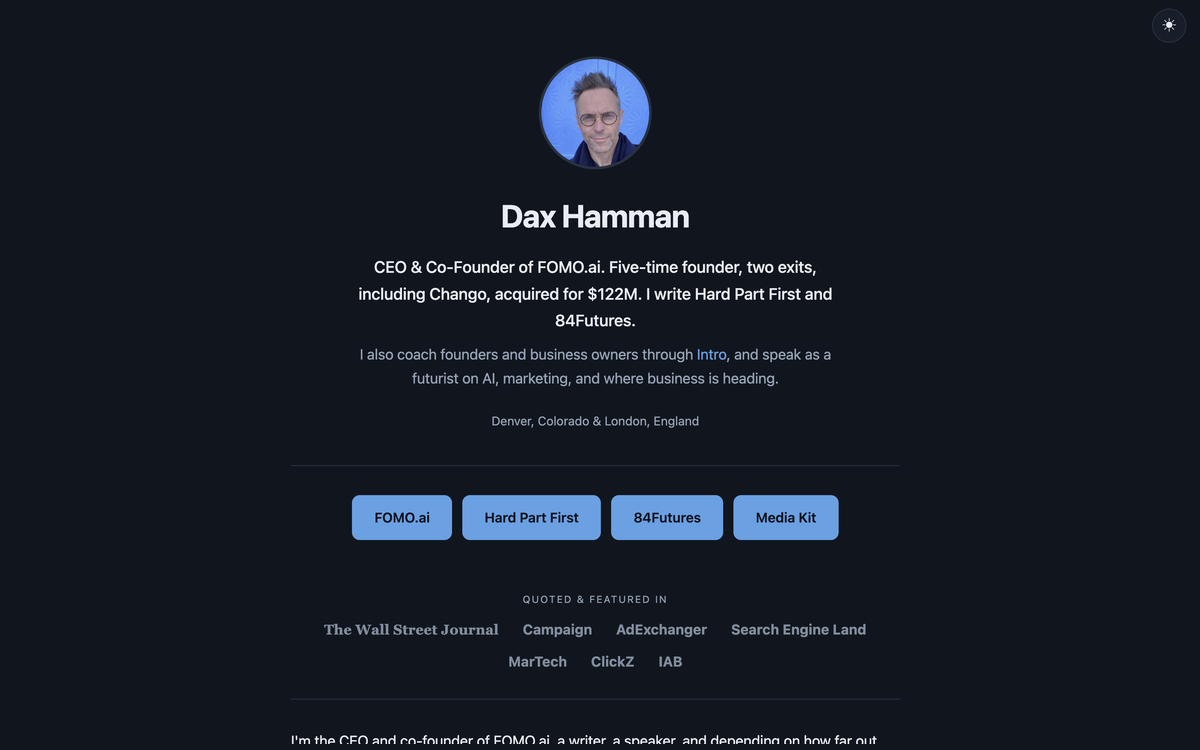
Google had split Dax (a Founder & CEO) into two people. His record was out of date and his best work was invisible. Investors and hosts looked him up, saw the wrong thing, and moved on.
One record of who he is and what he has done, on his own domain, updated with every new interview. Google merged the two profiles and he claimed his knowledge panel in September 2026. AI assistants now describe him accurately and cite dax.fyi as the source.
More podcast bookings. More consultancy relationships. The right investors taking the meeting. Linking the record to his company site (FOMO.ai) and newsletters lifted those in search too. Online, he now looks like the person he actually is.
AI tools build their answers from everything they can find about you, including your website, your profiles, your interviews and trusted sources like Wikidata, a public database of verified information, and Wikipedia. The most visible result is a Google knowledge panel, the box with your photo, title and key facts that appears when someone searches your name. Google and Wikipedia's editors decide who gets a panel or an article, so we never guarantee them. We build the verified record all of these sources rely on.
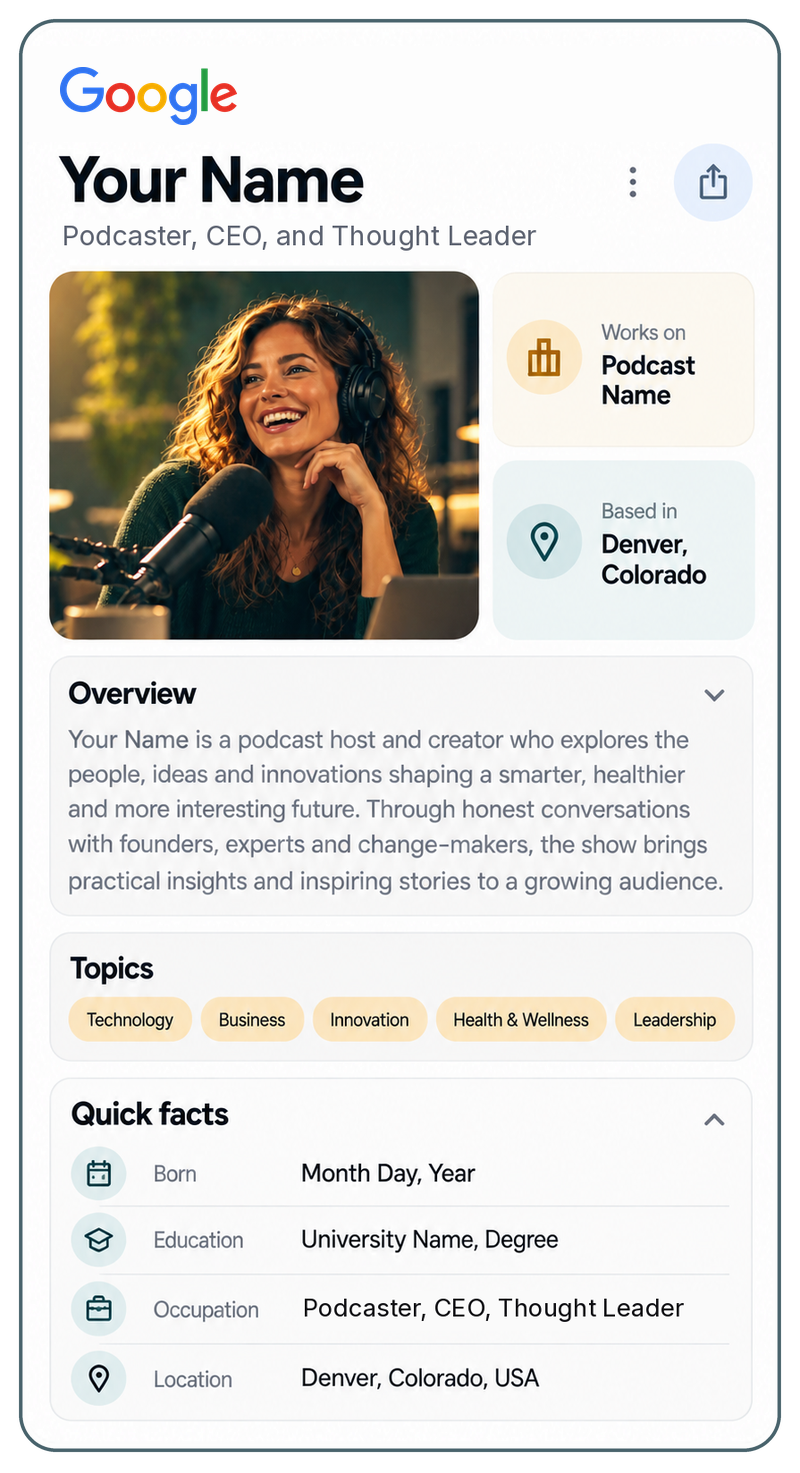
Google Knowledge Panel
Google builds one when enough trusted sources agree about who you are. The record, the matching profiles, the collected interviews and the Wikidata entry are exactly that agreement. When a panel appears we walk you through claiming it, and after the claim you control the photo, the subtitle and the links.
Wikidata
Wikidata is the open database behind Wikipedia, and Google treats it as a source it trusts. Where you qualify, with at least one independent outlet having written about you, we create and reference the entry as part of the setup. It is often the first thing to move attributes like education and birthplace into a panel.
Wikipedia
Wikipedia's bar for a living person is high and we will tell you plainly whether you clear it. If you do, the record and the collected coverage are what an article is written from, and we will never edit it on your behalf; that is the one thing that gets articles deleted. If you do not, the panel and the Wikidata entry do most of the same work.

No WordPress, no Squarespace, no Wix, no GoDaddy builder. Those platforms are frameworks from an older web: they sit between you and your page, add weight you never asked for, and were not designed for how Google and the AI assistants read a site today. Your site is pure. Just your pages, your words and the hidden layer the assistants read, with nothing else inside it, served from Cloudflare's global network from the location nearest whoever is looking.

 Seen onShark Tank


Nobody can promise that. Google builds the entity on its own schedule and shows the panel when it is confident. We build the record it reads, make every source agree, and teach the claim process for the day it appears.
The Foundation, delivered in 7 days: a deep scan of everything already written about you, your record, a site on your own domain with the hidden layer and a media kit, a consistency pass across your profiles, a strategy call where you approve your record line by line, Wikidata where you qualify, a readiness check against the Wikidata and Wikipedia criteria, Search Console, one press release, an AI answer check at day one, launch and day 90, and the Claim your Google Knowledge Panel course. Live on your own domain in 7 days, or your setup fee back.
Every client starts on Evolve ($149 a month, or $1,490 a year), where we host your site, re-run the deep scan every month for you to approve anything new, add anything you send us with no monthly cap, and report each month on how Google and AI describe you. Amplify ($295 a month, or $2,950 a year) adds a press release every quarter, written and optimized to be found in Google, AI Overviews and AI assistants. You can leave at any time: we deliver your complete site files at no additional charge, and your site stays live on our hosting until you move it or 30 days after launch, whichever comes first. Authority (from $750 a month, by application) adds outside coverage: more frequent press releases, podcast guest opportunities, interviews and PR, and guest article opportunities. Every plan includes our course, Claim your Google Knowledge Panel.
Our course on how Google, Wikidata and Wikipedia decide who gets an entry: the criteria, what counts as independent evidence, the proper routes, and a readiness scorecard that tells you plainly whether you are ready. It is included with every plan. It teaches how those decisions are made; we do not promise their outcome.
Good. If it states your facts plainly, carries one Person node with sameAs links, lists your appearances and your profiles all agree with it, you may not need the Foundation. Most personal sites do none of those. Schedule a call and we will tell you honestly.
Yes. The point is one address you control that everything else points at. If you do not have one, we help you choose and buy it, and you keep the registration. Hosting is included with Evolve, Amplify and Authority.
The site is live in 7 days. Assistants that search the web live reflect it within weeks of indexing. The ones answering from training data catch up when their models refresh, which can take months. The 90 day check shows you which is which.
You can leave at any time and we deliver your complete site files at no additional charge, which you can host anywhere. If you opt out at launch, your site stays live on our hosting until you move it or 30 days after launch, whichever comes first. If you end a paid plan later, we keep your site online for 30 days so you can move it. After that, hosting, updates, reports and outside work stop.
Plain explanations with diagrams and steps. No pitch inside; the footer does that.
A plain explanation of the Google knowledge panel, where it comes from, why most people never get one, and how to check whether Google has an entity for you.
Panel vendors have found lawyers, and lawyers are the worst possible buyers. A bought panel rests on the same fabricated sources Google removes, and for an attorney those sources are also communications about your services. What the vendors actually do, which professional conduct rules it runs into, and the honest route that ends in the same box.
Almost every referral ends in a name search, and for most attorneys that search shows directories, an old firm bio and someone else with the same name. A walk through the five things a prospect actually sees in Google and in ChatGPT, why each one happens, and the order to fix them in.